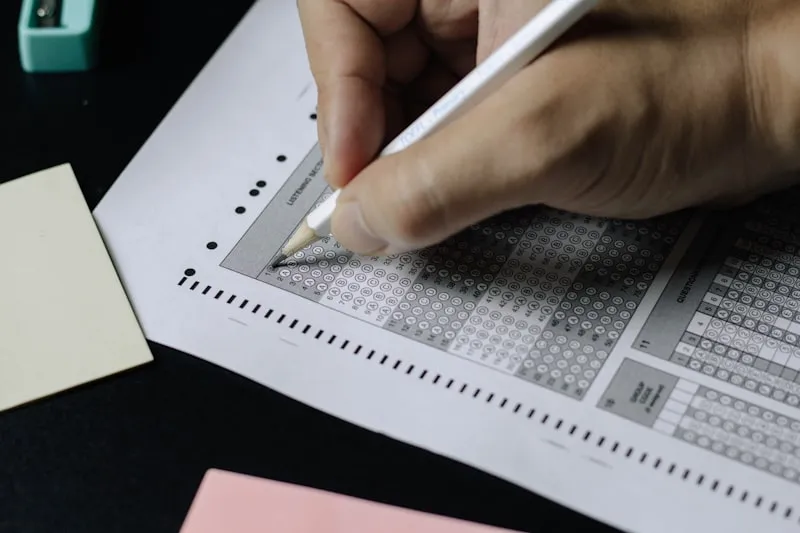
The Aufnahmepruefung (entrance exam) is the single most important step between you and a place at a German Studienkolleg. Every year, thousands of international students compete for a limited number of spots. The exam separates those who get in from those who must wait another semester — or look for alternatives. The competition is fierce: many Studienkollegs receive far more applications than they have seats, so passing the exam is necessary but not always sufficient. Places are awarded to the candidates with the best results.
This guide covers everything you need to know about the Aufnahmepruefung: what the exam looks like, what each section tests, and how different Studienkollegs structure their exams. Most importantly, it shows how to prepare systematically over 8 to 12 weeks so you walk into exam day confident and ready.
What Is the Aufnahmepruefung?
The Aufnahmepruefung is a standardized entrance test that every applicant must pass before being admitted to a Studienkolleg. Its purpose is twofold: first, to verify that your German language skills are strong enough to follow the demanding curriculum. Second, to confirm that you have the foundational subject knowledge — especially in mathematics — needed for your chosen Schwerpunktkurs (course track).
Unlike the Feststellungspruefung (FSP), which is the final exam at the end of the Studienkolleg year, the Aufnahmepruefung happens before you even begin your studies. Think of it as the gateway: the FSP is the finish line, the Aufnahmepruefung is the starting gate.
When Does the Exam Take Place?
The Aufnahmepruefung is held twice per year at most Studienkollegs:
Semester Start
Exam Period
Application Deadline
Summer semester (April)
January — February
October — November of the previous year
Winter semester (October)
June — July
April — May of the same year
Exact dates vary by institution. Always check the specific application deadlines for the Studienkolleg you are applying to.
Who Needs to Take the Exam?
Every applicant to a state (public) Studienkolleg must take the Aufnahmepruefung. There are very few exceptions:
Holders of a DSH-2 or DSH-3 certificate may be exempt from the German portion at some institutions
Applicants with a TestDaF result of TDN 4 in all sections may receive an exemption from the language test at selected Studienkollegs
Some private Studienkollegs use their own placement tests instead of the standard Aufnahmepruefung
However, the vast majority of applicants — regardless of nationality or prior qualifications — must sit the full exam.
Exam Structure: What to Expect
The Aufnahmepruefung consists of two parts: a German language test and a mathematics test. The exact structure varies between institutions, but the following breakdown reflects the most common format used across German Studienkollegs.
Part 1: German Language Test (60—90 Minutes)
The German test is mandatory for all course tracks (T, W, M, G, and S). It assesses whether your German skills are at or above the B2 level of the Common European Framework (CEFR). The test includes three to four sections:
Section A: C-Test (15—30 Minutes)
The C-Test is the signature element of the Studienkolleg German exam. You receive three to five short factual texts (60—80 words each) in which the second half of every other word has been deleted. Your job is to reconstruct the missing letters.
Example:
Original: “Die Universitat Heidelberg wurde im Jahr 1386 gegruendet und ist damit die aelteste Universitaet in Deutschland.”
C-Test version: “Die Uni_______ Heidelberg wu____ im Ja____ 1386 gegrue____ und i____ damit d____ aelteste Univer______ in Deutsch______.”
The C-Test measures your overall language competence — vocabulary, grammar, spelling, and contextual understanding — in a compressed format. It is deceptively difficult because you must process German at speed while simultaneously applying morphological and syntactic rules.
You read one or two longer texts (300—500 words) on general academic topics — science, society, education, environment — and answer comprehension questions. These may be:
Multiple-choice questions
True/false/not stated exercises
Short-answer questions requiring you to extract or reformulate information
The texts are written at a B2—C1 level and often use academic register, which means you encounter passive constructions, nominalized verbs, and complex sentence structures.
Section C: Grammar / Lueckentext (15—20 Minutes)
A gap-fill exercise where you insert the correct grammatical form (verb conjugation, adjective ending, preposition, article) into a text. Some Studienkollegs integrate this into the C-Test; others test it separately.
Relative clauses and subordinate clause word order
Adjective declension (after definite/indefinite articles, without articles)
Passive voice (Vorgangspassiv and Zustandspassiv)
Prepositions with accusative, dative, and genitive
Section D: Text Production / Textproduktion (30—40 Minutes)
Not every Studienkolleg includes a writing section in the Aufnahmepruefung (many reserve this for the FSP), but some do. When present, you write a short text (150—250 words) on a given topic — for example summarizing a text, responding to a statement, or describing a chart or diagram.
Part 2: Mathematics Test (45—60 Minutes)
The math test is required for applicants to the T-Kurs, M-Kurs, and W-Kurs. Some Studienkollegs also test math for other course tracks, while others only require the German test for G-Kurs and S-Kurs applicants.
For G-Kurs and S-Kurs applicants, some institutions replace the math test with a chart evaluation test (Diagrammauswertung). You receive one or more charts or graphs and must judge whether a series of statements about the data are correct, incorrect, or cannot be determined.
Math Topics Covered
The mathematics entrance exam covers content roughly equivalent to German secondary school mathematics up to grade 10, with some topics from grades 11 and 12. Here is a detailed breakdown:
Topic Area
Specific Content
Arithmetic & Algebra
Operations with fractions, powers, and roots; simplifying algebraic expressions; factoring polynomials; rules of logarithms
Equations & Inequalities
Linear equations and inequalities; quadratic equations (including the quadratic formula); systems of linear equations (2 variables); equations with fractions and radicals
Functions
Linear functions (slope, intercepts); quadratic functions (vertex, roots, graphing); power functions; exponential and logarithmic functions; recognizing function graphs
Geometry
Area of triangles, rectangles, circles, and composite shapes; Pythagorean theorem; intercept theorems (Strahlensaetze); volume and surface area of cylinders, cones, and spheres; basic trigonometry (sin, cos, tan)
All tasks are written in German. You need to know mathematical terminology in German (see vocabulary list below).
Calculators are not permitted at most Studienkollegs. You must calculate by hand.
The official mathematics formula sheet (Formelsammlung) may or may not be provided — check with your specific Studienkolleg.
At Studienkolleg Bochum, the test consists of approximately six tasks and lasts 30 minutes. At TU Berlin, it lasts 45 minutes. At Studienkolleg Coburg, 60 minutes. Plan for variation.
Essential Math Vocabulary in German
If you learned mathematics in another language, this vocabulary list is critical:
German
English
die Gleichung
equation
die Ungleichung
inequality
der Bruch
fraction
die Potenz
power/exponent
die Wurzel
root (square root)
der Logarithmus
logarithm
die Funktion
function
die Gerade
straight line
die Parabel
parabola
der Scheitelpunkt
vertex
die Nullstelle
root/zero of a function
die Steigung
slope/gradient
der Flaecheninhalt
area
der Umfang
perimeter/circumference
das Dreieck
triangle
der Kreis
circle
die Kugel
sphere
der Zylinder
cylinder
der Kegel
cone
der Satz des Pythagoras
Pythagorean theorem
die Ableitung
derivative
die Wahrscheinlichkeit
probability
How Different Studienkollegs Structure Their Exams
While the general framework is similar across Germany, each Studienkolleg sets its own exam. Here are the key differences you should be aware of:
Studienkolleg at FU Berlin
German test: C-Test (three texts, 75 gaps, 30 minutes) plus grammar and reading comprehension
Math test: algebra, functions, geometry, 45 minutes
No writing section in the entrance exam
Studienkolleg at TU Berlin
German test: C-Test and Lueckentext
Math test: basic algebra, functions, geometry with sample problems published online
Emphasis on ability to follow German-language mathematical instructions
Studienkolleg at Heidelberg University (ISZ)
German test: C-Test, reading comprehension, grammar
Math test: covers content up to grade 12, including basic analysis
Places awarded strictly by ranking — even a passing score may not guarantee admission
Studienkolleg Munich (Bayern)
German test: C-Test and reading comprehension
Math test required for T, M, and W-Kurs applicants
Extremely competitive due to high applicant numbers
May use digital exam platforms (ExamRoom.AI at FH Aachen)
German test structure similar to university Studienkollegs
Math test may be slightly less demanding than university-level Studienkollegs
Some include subject-specific aptitude questions
Key Takeaway
Always download and study the sample exams (Musteraufnahmetests) published by your target Studienkolleg. These are the single best predictor of what your actual exam will look like. Visit our sample exams page for a curated collection of official practice materials from over 20 Studienkollegs.
What to Expect on Exam Day
Knowing what exam day actually looks like can significantly reduce your anxiety. Here is a step-by-step walkthrough:
Before the Exam
Arrive early. Most Studienkollegs open their doors 30—60 minutes before the exam starts. Being late may disqualify you.
Bring your documents: Valid passport or ID card, your Vormerkung (registration confirmation), and any correspondence from the Studienkolleg.
Bring writing materials: Black or blue pen (some require pencil). Do not rely on the institution providing pens.
Leave electronics behind. Mobile phones, smartwatches, and electronic dictionaries must be switched off and stored away. Violations can lead to immediate disqualification.
During the Exam
ID check. Your identity will be verified at the beginning of the exam.
German test first. Most Studienkollegs begin with the German language test. You receive the test booklet and answer sheet. Read all instructions carefully — they are in German.
Short break. There is a 10—15 minute break between the German and math tests.
Math test second. You receive the math exam. Remember: no calculator. All work must be shown on the provided paper.
Time management. You cannot go back to the German test once it has been collected. Budget your time carefully within each section.
After the Exam
Results timeline. Most Studienkollegs notify applicants within 2—4 weeks. Some publish results online; others send letters.
Ranking system. Passing is not always enough. If 200 students pass but only 80 places are available, only the top 80 will be admitted.
Failed? You can retake the exam in the following semester. There is no limit on attempts at most institutions, but each attempt costs time — usually six months until the next exam date.
Subject-by-Subject Preparation Guide
Preparing for the German Test
Building Your C-Test Skills
The C-Test is the section that surprises most students. It looks simple but requires deep, automatic language processing. Here is how to prepare:
Practice with real C-Tests daily. Use the free C-Test trainer at c-tester.com, which generates unlimited C-Tests from authentic German texts. Aim for 3—5 tests per day.
Read German news articles every day. Sources like Deutsche Welle (dw.com), Tagesschau, and ZEIT Online expose you to the academic register and vocabulary that appear in the exam. Read at least one article per day and note unfamiliar words.
Study word formation patterns. German heavily uses prefixes (ver-, be-, er-, ent-, zer-) and suffixes (-ung, -keit, -heit, -lich, -isch). Understanding these patterns helps you reconstruct deleted word halves in the C-Test.
Master compound nouns. Words like “Hochschulzugangsberechtigung” or “Aufnahmepruefung” are common in academic texts. Practice breaking them apart and putting them together.
Drill verb conjugation tables. The C-Test frequently deletes verb endings. You must instantly know the correct form for every person, tense, and mood.
Improving Reading Comprehension
Practice skimming and scanning. You do not have time to read every word carefully. Train yourself to identify main ideas quickly.
Learn to paraphrase. Many comprehension questions test whether you can express the same idea in different words.
Build academic vocabulary. Focus on words that appear across disciplines: “Ergebnis” (result), “Zusammenhang” (connection), “Einfluss” (influence), “Entwicklung” (development), “Bedeutung” (meaning/significance).
Strengthening Grammar
Focus on the top error areas: adjective declension, relative clauses, passive voice, Konjunktiv II, and prepositions with the correct case.
Use a structured grammar book. Recommended: “Grammatik aktiv B2—C1” (Cornelsen) or “em Uebungsgrammatik” (Hueber).
Do timed grammar exercises. Speed matters in the exam. Practice filling in gaps under time pressure.
Preparing for the Math Test
Week-by-Week Topic Plan
Weeks 1—2: Arithmetic and Algebra Foundations
Review operations with fractions (addition, subtraction, multiplication, division of fractions)
Practice power rules: a^m * a^n = a^(m+n), (a^m)^n = a^(mn), a^(-n) = 1/a^n
Simplify algebraic expressions and factor polynomials
Solve linear equations and inequalities
Weeks 3—4: Quadratic Equations and Systems
Master the quadratic formula: x = (-b +/- sqrt(b^2 - 4ac)) / 2a
Practice completing the square and factoring
Solve systems of two linear equations (substitution and elimination methods)
Work through word problems that translate into equations
Weeks 5—6: Functions and Graphs
Plot linear and quadratic functions by hand
Identify vertex, axis of symmetry, and roots of parabolas
Understand exponential growth and decay (f(x) = a * b^x)
Practice recognizing and matching function types to their graphs
Weeks 7—8: Geometry
Review area formulas: triangles, rectangles, trapezoids, circles
Practice Pythagorean theorem problems
Calculate volumes of cylinders, cones, and spheres
Work through intercept theorem (Strahlensaetze) exercises
Practice basic trigonometry: sin, cos, tan in right triangles
Approach: Apply the quadratic formula. Discriminant = 25 + 24 = 49. Solutions: x = (5+7)/4 = 3 and x = (5-7)/4 = -1/2.
Problem 3 (Geometry): A cylinder has a radius of 5 cm and a height of 12 cm. Calculate the volume and total surface area.
Approach: Volume = pi * r^2 * h = pi * 25 * 12 = 300pi cm^3. Surface area = 2 * pi * r^2 + 2 * pi * r * h = 50pi + 120pi = 170pi cm^2.
Problem 4 (Functions): The function f(x) = x^2 - 6x + 5 is given. Find the vertex, the roots, and sketch the graph.
Approach: Roots via factoring: (x-1)(x-5) = 0, so x = 1 and x = 5. Vertex at x = 3: f(3) = 9 - 18 + 5 = -4. Vertex: (3, -4). Parabola opens upward.
Problem 5 (Logarithms): Solve for x: log_2(x) + log_2(x-2) = 3
Approach: Combine: log_2(x(x-2)) = 3, so x(x-2) = 8. Solve x^2 - 2x - 8 = 0. Solutions: x = 4 (valid) and x = -2 (rejected because log of negative number is undefined).
Recommended Preparation Timeline (12 Weeks)
Week
German Focus
Math Focus
Hours/Day
1—2
C-Test introduction, daily reading, vocabulary building
Fractions, powers, algebraic expressions
2—3
3—4
C-Test practice (3/day), grammar review (adjective declension, cases)
Full German practice tests, text production practice
Logarithms, advanced topics, mixed problem sets
4—5
11—12
Full exam simulations, review weak areas, speed drills
Full math simulations under exam conditions, mental arithmetic
4—5
Total preparation time: approximately 250—350 hours over 12 weeks.
If you have only 8 weeks, compress weeks 1—2 and 3—4 into single weeks each, and spend more time on practice exams in the final two weeks. The minimum viable preparation time is 6 weeks, but only if your German is already at a strong B2 level and your math foundations are solid.
Free Resources for Exam Preparation
Official Sample Exams
The most valuable preparation materials are official sample exams published by Studienkollegs themselves. We have collected and organized these on our dedicated resource page:
Browse All Sample Exams — Free practice exams from over 20 Studienkollegs, organized by exam type (entrance exam vs. assessment exam) and subject (German, math, physics, chemistry, and more).
Specific collections worth downloading:
Entrance Exam Samples — Sample Aufnahmepruefung papers with C-Tests, grammar exercises, and math problems
German Sample Exams — C-Test, Leseverstehen, and Textproduktion practice from multiple institutions
Math Sample Exams — Problems covering algebra, functions, geometry, and analysis
Online Tools and Practice Platforms
C-Tester.com — Free, unlimited C-Test practice with authentic German texts
Deutsche Welle (dw.com/de) — Free German learning resources, news articles, and grammar exercises
Khan Academy (German version) — Free math tutorials covering all entrance exam topics
GeoGebra — Free graphing tool to visualize functions and geometric shapes
Textbooks
German: “Grammatik aktiv B2—C1” (Cornelsen), “Erkundungen C1” (Schubert Verlag)
Math: “Lambacher Schweizer Mathematik” (Klett) — the standard German high school textbook, or “Mathematik fuer Studienkollegs” if available from your institution
C-Test specific: “C-Tests: Preparation and Practice” resources available through your language school or Studienkolleg
Common Mistakes to Avoid
Mistake 1: Underestimating the German Test
Many students focus almost exclusively on math preparation because it feels more “studyable.” But the German test carries equal weight, and the C-Test in particular requires months of consistent practice. Students who neglect the German portion often fail the entire exam.
Mistake 2: Preparing with the Wrong Math Level
Some students study calculus and advanced analysis, thinking the harder the better. The Aufnahmepruefung tests secondary school mathematics, not university-level content. Focus on fundamentals: clean arithmetic, confident algebra, solid geometry. Mastering the basics with speed and accuracy beats superficial knowledge of advanced topics.
Mistake 3: Ignoring German Mathematical Terminology
You may be excellent at math but unable to understand the questions because they are written in German. “Bestimmen Sie die Nullstellen der Funktion” means “determine the roots of the function.” If you do not know the terminology, you cannot solve the problem. Study the vocabulary table above and practice reading math problems in German.
Mistake 4: Not Practicing Under Timed Conditions
The Aufnahmepruefung is timed. If you always practice without a clock, you will be shocked by how quickly 45 minutes pass during the math exam. From week 6 onward, do every practice session with a timer.
Mistake 5: Applying to Only One Studienkolleg
This is not an exam mistake but an application mistake. Competition varies enormously between institutions. If you apply to only one highly competitive Studienkolleg (like Berlin or Munich) and do not get in, you lose an entire semester. Apply to multiple Studienkollegs to maximize your chances.
Mistake 6: Not Practicing Mental Arithmetic
Calculators are not allowed. If you have been relying on a calculator for years, you need to retrain your mental math skills. Practice multiplying two-digit numbers, dividing fractions, and estimating square roots by hand.
Mistake 7: Starting Too Late
One week of preparation is not enough — regardless of how talented you are. Students who fail the Aufnahmepruefung most commonly cite insufficient preparation time as the reason. Start at least 8 weeks before the exam, ideally 12.
Frequently Asked Questions
What German level do I need to pass the Aufnahmepruefung?
Most Studienkollegs require at least a B1 certificate to register for the exam, but the exam itself tests at a B2 level. Experience shows that students with a solid B2 level have a realistic chance of passing. Students at B1 level will find the exam extremely challenging. Aim for B2 before exam day.
Can I take the Aufnahmepruefung more than once?
Yes. At most Studienkollegs, you can retake the exam in the following semester. There is no limit on the number of attempts at most institutions. However, each failed attempt means waiting approximately six months for the next exam date, which delays your studies significantly.
What happens if I pass the exam but do not get a place?
Because admission is competitive, passing the exam does not guarantee a seat. If your score is not high enough to earn a place, you can retake the exam next semester to try for a higher score. Alternatively, you can apply to a less competitive Studienkolleg where your existing score may be sufficient.
Is the math test required for G-Kurs and S-Kurs applicants?
Not always. Many Studienkollegs test only German for G-Kurs (humanities) and S-Kurs (languages) applicants. Some institutions replace the math test with a chart evaluation or textual analysis exercise. Check with your target Studienkolleg to confirm which tests you must take.
Can I use a calculator during the math exam?
No. The vast majority of Studienkollegs prohibit all calculators — including simple scientific calculators. Some institutions in certain states may allow a basic scientific calculator (WTR) but explicitly ban graphing calculators (GTR) and programmable calculators. Assume no calculator unless your specific Studienkolleg states otherwise.
How is the exam scored? Is there a specific passing grade?
Scoring methods vary by institution. Some use a point system where you need a minimum percentage (often 60—70%) to pass. Others use the German grading scale where you need at least a 4.0 (equivalent to “ausreichend” / sufficient). Remember: even if you score above the passing threshold, you need to rank high enough among all applicants to actually secure a place.
Should I prepare differently for a Fachhochschule Studienkolleg vs. a University Studienkolleg?
The exam structure is similar, but Fachhochschule Studienkollegs (offering TI, WW, GD, and SW courses) may have a slightly more applied focus in their math questions. The German test is comparable. The biggest difference is that passing an FH Studienkolleg FSP later only qualifies you for Fachhochschulen, not traditional universities — so choose your Studienkolleg type carefully based on your long-term goals.
What if my preferred Studienkolleg is full? Can my exam result be transferred?
Generally, no. Each Studienkolleg administers its own entrance exam and does not accept results from other institutions. If you want to keep your options open, you must take the entrance exam at each Studienkolleg separately. Some states are beginning to coordinate — for example, all Bavarian Studienkollegs use the same exam administered by the central Studienkolleg in Munich — but this is the exception, not the rule.
Your Next Steps
Identify your target Studienkollegs and check their specific exam requirements and deadlines. Our Studienkolleg finder can help.
Download sample exams from our sample exams page and your target institution’s website.
Create your 12-week study plan using the timeline above.
Start daily C-Test practice and math drills immediately.
Take a full practice exam under timed conditions at least twice before the real test.
Apply to multiple Studienkollegs to maximize your chances of getting a place.
The Aufnahmepruefung is challenging, but it is not unpredictable. Every exam follows a known format, tests known topics, and rewards systematic preparation. Students who put in consistent work over 8—12 weeks pass. Students who rush or underestimate the exam do not. Start early, practice daily, and you will walk into exam day ready.
 admission